
For most businesses, energy is a controllable cost hiding in plain sight. Unlike a home bill, a commercial bill has several components, and the biggest savings often come from the parts owners never look at: demand charges, the tariff structure, and the contract itself. Work through them in order and you can cut the bill before spending a cent on hardware, then use solar to cut it further.
Read your bill properly first
A commercial electricity bill is not one price per unit. It usually splits into a few distinct charges, and knowing which is which tells you where the money is going.
- Usage (consumption) charges. Cents per kilowatt-hour for the energy you actually use. Often billed at different rates by time of day on a time-of-use tariff.
- Demand (or capacity) charges. Based on your highest rate of power draw in a billing period, not your total usage. On larger sites this can be a very big slice of the bill.
- Supply and network charges. Fixed daily charges for being connected, plus network costs passed through by the distributor.
- Metering, environmental and market fees. Smaller line items, but worth understanding so nothing is a surprise.
Understand demand and peak charges
Demand charges are the part most businesses do not understand, and they are often where the largest saving sits. A demand charge is based on your peak power draw, typically the highest half-hour of usage in the period, measured in kilowatts or kVA. You can use the same total energy across a month but pay very different demand charges depending on how spiky your load is.
Two sites can use identical total energy. The one that draws it in sharp spikes pays far more, because demand charges price the peak, not the total.
That gives you a clear lever: flatten your peaks. Practical ways to do it include:
- Stagger heavy equipment. Avoid starting large motors, compressors, ovens or chillers all at once. Sequencing start-ups keeps the peak down.
- Shift flexible loads off the peak window. Move non-urgent, energy-hungry tasks outside your busiest half-hours where the process allows.
- Watch simultaneous loads. Sometimes a single coinciding event, everything running at once on a hot afternoon, sets your demand charge for the whole period.
- Consider storage for peak shaving. A commercial battery can discharge during a demand spike to cap the peak the network sees, which directly reduces the demand charge.
Review your tariff and contract
Many businesses are on the wrong tariff or an expired contract and do not know it. This is a low-effort, high-value check.
- Match the tariff to your load shape. A site that runs mostly in daylight suits a different tariff from one that runs around the clock. The wrong tariff can quietly cost thousands a year.
- Re-tender your retail contract. If your contract has rolled onto default rates, going back to market or comparing offers can cut the usage rate straight away.
- Check your demand threshold. On some tariffs a modest cut in peak demand moves you into a cheaper band, compounding the saving from peak shaving above.
- Read the network tariff too. The distributor's network charges are a large, often overlooked part of the bill, and the network tariff assigned to your site is sometimes negotiable or changeable.
Find the efficiency wins
The same principle as a home applies at scale: the cheapest kilowatt-hour is the one you never buy. Commercial efficiency projects often pay back quickly because the volumes are large.
- Lighting. LED upgrades and occupancy sensors in warehouses, offices and car parks are among the fastest-payback projects available.
- HVAC. Servicing, controls and setpoint discipline on heating and cooling cut a major load. Modern controls that avoid running empty spaces are cheap wins.
- Motors, pumps and compressors. Variable-speed drives and fixing compressed-air leaks recover energy that is otherwise wasted continuously.
- Refrigeration. For hospitality, retail and cold storage, well-maintained and correctly controlled refrigeration is a large and controllable cost.
Where commercial solar changes the numbers
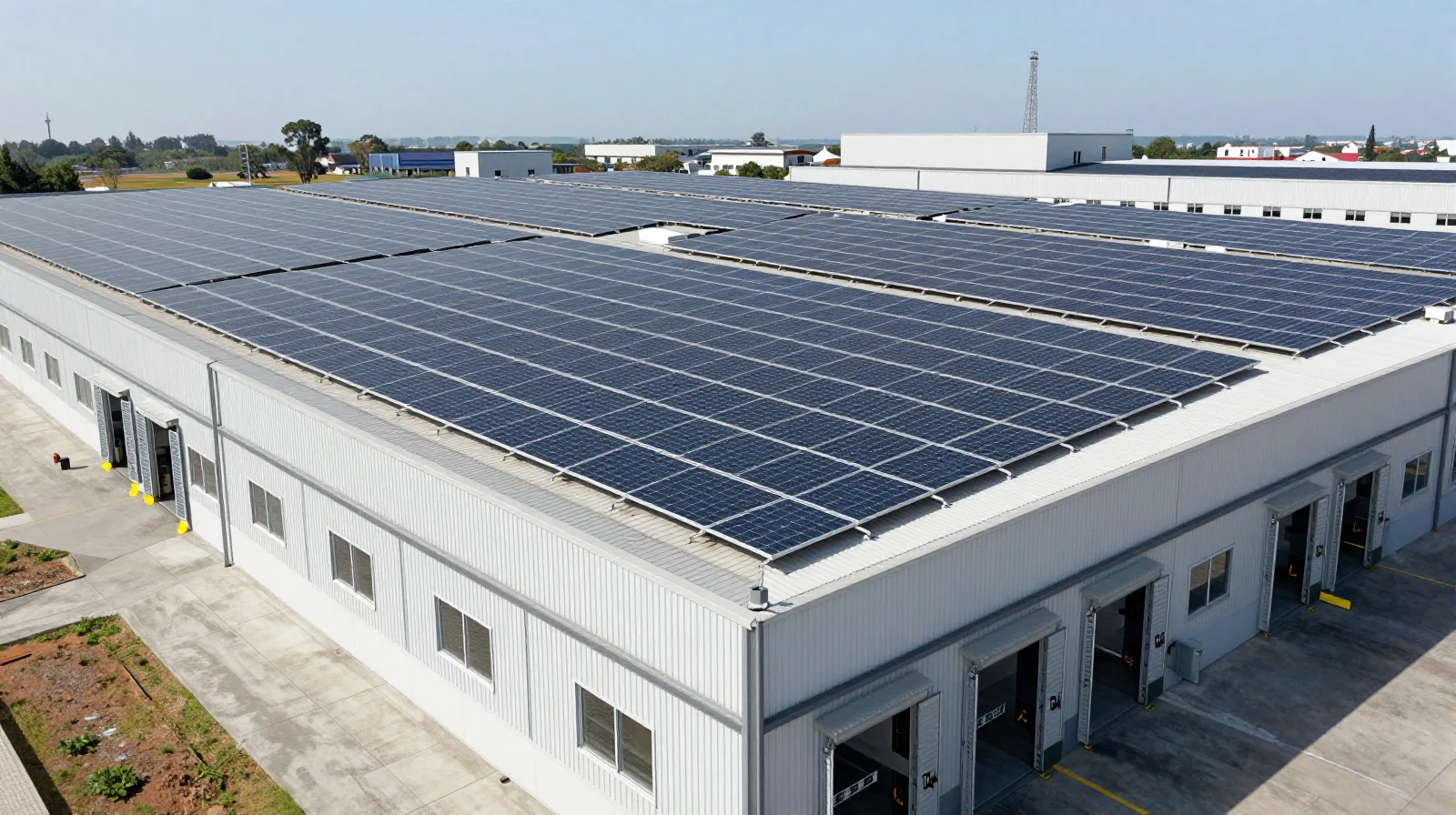
Once you have flattened peaks, fixed the tariff and trimmed waste, solar attacks the remaining daytime usage directly, and most businesses use the bulk of their power during daylight hours. That alignment is exactly what makes commercial solar work.
- High daytime self-consumption. A business open through the day uses most of its solar on site, at the full retail rate it would otherwise pay. That is where commercial solar earns its return.
- Demand-charge relief. Solar generating through the middle of the day can lower the grid demand your site draws in that window, easing demand charges as well as usage charges.
- Scale and payback. Commercial systems from around 30kW to 100kW and beyond are sized to your roof and load. Because the self-consumed power offsets business-rate electricity, the payback case is often strong.
- A clear ROI, not a guess. A proper commercial proposal models your actual load profile against generation, so you see the return before you commit.
A sensible order for a business
Sequence the work so the cheap checks come first and each step sharpens the case for the next.
- Read your bill and identify your demand charges and tariff.
- Flatten your peaks and re-tender your retail contract.
- Do the fast-payback efficiency projects, starting with lighting and HVAC controls.
- Size commercial solar, and storage if peak shaving stacks up, against your real load profile.
- Get a commercial quote with a modelled ROI for your site.